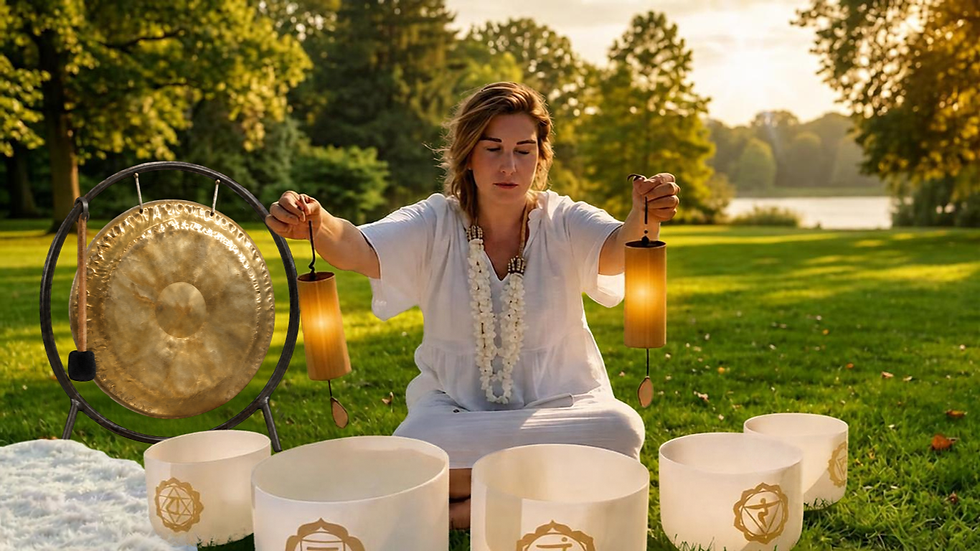
What is Sound Healing?
Sound Healing - Ancient Sound, Modern Science
Sound has been part of the human experience for thousands of years. Across cultures, people have used music, voice, rhythm, chanting, drums, bells, and resonant instruments to create connection, encourage reflection, support meditation, and promote a sense of wellbeing.
Today, we are beginning to understand more about why sound can have such a powerful effect on how we feel. Modern neuroscience gives us new tools for understanding some of the ways sound interacts with the brain and body, but there is still much to discover.
We now know that sound can influence attention, perception, emotion, neural activity, and physiological processes. We also know that the experience is deeply individual.
What Is Sound Healing?
Sound healing is an immersive wellness practice that uses sound, vibration, rhythm, resonance, and intentional listening to create an environment conducive to relaxation and restoration.
During a sound healing experience, instruments such as singing bowls, gongs, chimes, drums, and other resonant instruments create layers of sound that move through the space.
Rather than actively participating, you are invited to slow down and listen.
Sound naturally captures our attention. As you listen to the changing tones, harmonics, rhythms, and vibrations, your awareness can shift away from the constant stream of thoughts and external demands that occupy everyday life.
This creates an opportunity to pause, breathe, and become more aware of the present moment.
Research into music and sound suggests that auditory experiences can influence areas of the brain involved in attention, emotion, memory, and autonomic regulation, while also influencing physiological measures such as heart rate and respiration.
Sound healing is best understood as a complementary wellness experience that may support relaxation, stress reduction, mindfulness, and overall wellbeing.
What Is a Sound Bath?
A sound bath is an immersive experience in which you are invited to get comfortable, close your eyes, and simply receive the sounds around you.
You don't need to know how to meditate or have any previous experience with sound healing.
You simply listen.
A sound bath may incorporate singing bowls, gongs, chimes, drums, and other instruments to create an evolving landscape of tones, harmonics, overtones, resonance, and vibration.
As the sounds move through the space, you may notice changes in your breathing, physical sensations, thoughts, emotions, or your overall sense of awareness.
Some people experience profound relaxation. Others describe feeling grounded, refreshed, mentally quieter, or more connected to themselves.
Every experience is different.
There is no right way to experience a sound bath.
The invitation is simply to slow down, become still, and listen.
The Neuroscience of Sound Baths
There is more happening during a sound bath than simply hearing beautiful sounds.
Sound is processed throughout the brain through an interconnected network that involves the auditory system, brainstem, thalamus, auditory cortex, attention networks, and regions associated with emotion and memory.
Because of these connections, sound can influence both our perception and our physiological state.
How the Brain Processes Sound
When an instrument produces a sound, it creates vibrations that travel through the air as changes in pressure.
Your ears detect those changes and convert them into electrical signals that travel through the auditory system to the brain.
The brain then interprets characteristics such as:
-
Frequency and pitch
-
Volume and intensity
-
Rhythm and timing
-
Timbre and texture
-
Harmonics and overtones
-
Spatial location
But the brain doesn't simply "hear" these characteristics.
It is continuously determining what the sounds mean, whether they require attention, and how they relate to the surrounding environment.
This is one reason sound can influence our emotional and physiological experience so quickly.
Vibrational Frequencies
Frequency refers to how many times a sound wave cycles per second and is measured in hertz (Hz).
For example, a 100 Hz sound completes approximately 100 cycles per second.
Frequency influences the pitch we perceive—lower frequencies generally sound deeper, while higher frequencies sound higher.
But a sound is much more than its fundamental frequency.
Singing bowls, gongs, and other resonant instruments produce complex combinations of fundamental tones, harmonics, overtones, and changing frequencies.
This complexity contributes to the richness and evolving quality of their sound.
What About Specific Healing Frequencies?
You may have heard claims surrounding frequencies such as 432 Hz or 528 Hz.
There is ongoing research into how different frequencies and forms of auditory stimulation may influence perception, mood, and physiological responses. However, scientific evidence does not currently establish that a particular frequency universally heals a specific organ, cell, or medical condition.
The science is more nuanced—and more interesting.
Our brains respond not only to frequency, but also to rhythm, pattern, timing, complexity, volume, expectation, emotion, and context.
Brain Entrainment
The brain is constantly producing patterns of electrical activity that can be measured using technologies such as EEG, or electroencephalography.
These patterns are often described using frequency ranges, including delta, theta, alpha, beta, and gamma.
Delta
Approximately 0.5–4 Hz
Most prominent during deep sleep.
Theta
Approximately 4–8 Hz
Associated with drowsiness, memory processes, and certain meditative states.
Alpha
Approximately 8–13 Hz
Often associated with relaxed wakefulness.
Beta
Approximately 13–30 Hz
Common during active thinking, concentration, and problem-solving.
Gamma
Generally above 30 Hz
Associated with a range of higher-order cognitive processes.
These frequency bands are not isolated "states." The brain produces multiple rhythms simultaneously, and their activity changes continuously depending on what we are doing, thinking, and experiencing.
Can Sound Influence Brain Activity?
Yes. The brain is highly responsive to rhythmic sensory information. Research has demonstrated measurable neural responses that synchronize with aspects of rhythmic auditory stimulation.
This phenomenon is broadly referred to as neural entrainment.
In simple terms, the brain can track patterns in sound.
This doesn't mean that listening to a particular sound automatically puts the entire brain into a specific brainwave state. Rather, it means that the nervous system is capable of responding to rhythmic auditory information in measurable ways.
Researchers continue to investigate how this interaction may relate to attention, perception, relaxation, cognition, and emotional states.
Binaural Beats
Binaural beats are another fascinating example of how the brain processes sound.
They are created when two slightly different frequencies are presented separately to each ear, typically through headphones.
For example:
Left ear: 400 Hz
Right ear: 410 Hz
The brain perceives a rhythmic fluctuation corresponding to the 10 Hz difference between the two tones.
That perceived beat is not actually being played as a separate sound. It is an auditory phenomenon created by the way the brain processes the two frequencies.
Researchers have studied binaural beats using EEG and other measures to explore their potential effects on attention, mood, relaxation, sleep, and neural activity.
Some studies have reported changes associated with auditory entrainment, while others have found inconsistent results. Research is ongoing.
What makes binaural beats particularly interesting is that they demonstrate something fundamental about neuroscience:
The brain doesn't simply receive sound. It actively constructs our experience of sound.
Sound, Attention & The Nervous System
One of the most important aspects of a sound bath may be the relationship between sound and attention.
Throughout the day, our attention is constantly being pulled in different directions—work, conversations, notifications, responsibilities, decisions, and the thoughts running through our minds.
During a sound bath, attention has a different focal point:
The sound.
Listening to the evolving tones and vibrations can provide an anchor for attention and create an opportunity to step away from some of the mental demands of everyday life.
At the same time, the autonomic nervous system—the system responsible for regulating many involuntary functions of the body—continues to respond to the experience.
Music and sound research has investigated changes in measures including:
-
Heart rate
-
Respiration
-
Blood pressure
-
Heart-rate variability
-
Skin conductance
-
Subjective stress and relaxation
The results vary depending on the individual, the type of sound or music, and the conditions of the experience, but research continues to explore how auditory stimulation interacts with physiological regulation.
Sound & Stress
Stress is not simply something that happens "in your head."
It involves an interconnected network of brain regions, the autonomic nervous system, and hormonal systems that help the body respond to perceived demands or threats.
When we experience stress, the body can become more alert and activated.
When the conditions around us signal safety and allow us to rest, the body has an opportunity to move toward a more restorative state.
A sound bath creates a period of intentional stillness where there is little to accomplish and nowhere else to be.
The combination of stillness, focused listening, breathing, sensory experience, and a supportive environment may help create the conditions for relaxation.
Why Sound Can Feel So Different From Person to Person
There is no single response to sound.
The brain's response to an auditory experience can be influenced by personal preferences, memories, emotional associations, expectations, environment, and individual differences in sensory processing.
The same sound that feels deeply relaxing to one person may feel neutral—or even stimulating—to another.
That's part of what makes sound so personal.
A sound bath isn't about producing one predetermined response.
It's about creating an environment where you can experience sound in your own way.